
GUIDANCE FOR NEW RESEARCHERS
CO-AUTHORSHIP
Why this guidance exists
Being named as a co-author is a form of academic credit and academic responsibility, rather than simply being involved in a project. Problems arise when people who helped make a project happen are added as co-authors even though they did not contribute to the written, analytical or scholarly work itself. This creates unfair credit, can mislead readers about who is answerable for the content, and can cause difficulties if the work is later questioned.
This sheet sets out a shared standard, based on internationally recognised research-integrity guidance (ICMJE and COPE — see Sources), so that everyone at IML applies the same test when deciding who is listed as an author, who is acknowledged instead, and how author order is agreed.
What's expected of a named co-author
IML uses the test set out by the International Committee of Medical Journal Editors (ICMJE), now widely adopted well beyond medicine and endorsed by the Committee on Publication Ethics (COPE). To be listed as a co-author, a person must meet all four of the following — not just one or two:
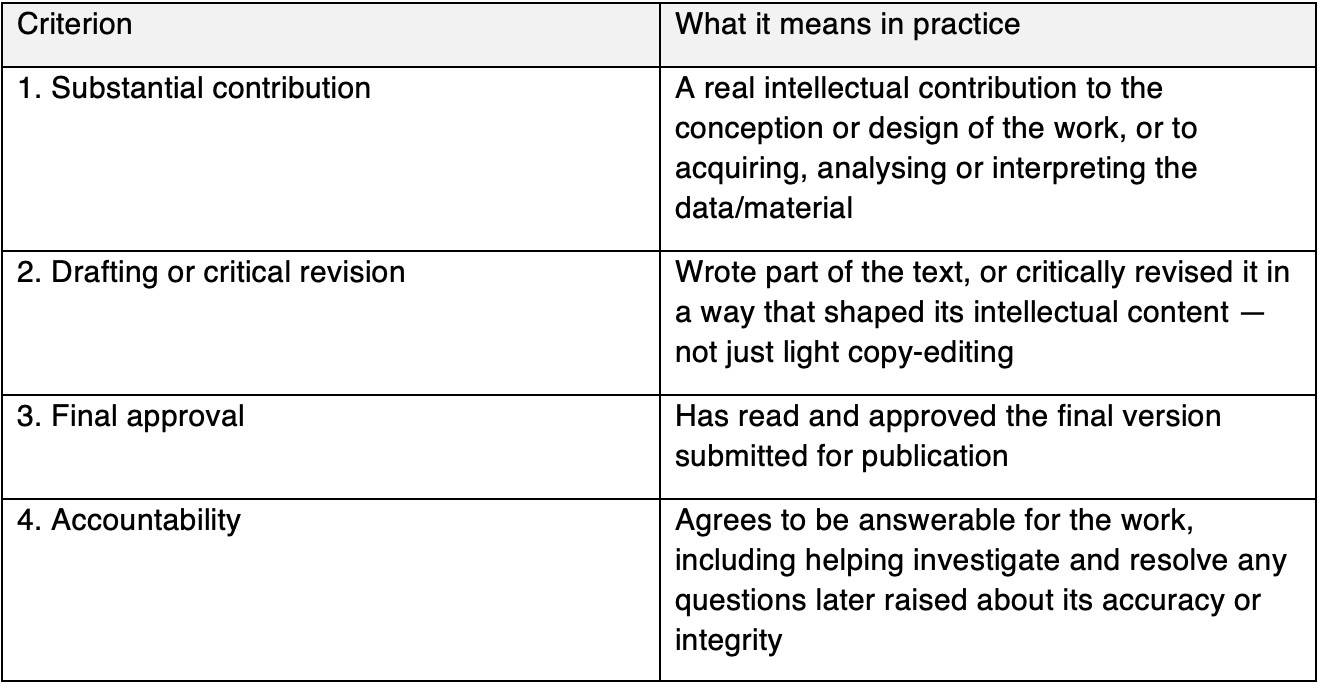
Meeting only one or two of these (for example, providing data but never seeing the final text, or approving a version without having contributed to the design or analysis) is not enough for authorship.
For projects with several contributors, it can help to record roles explicitly using the CRediT taxonomy (conceptualisation, methodology, investigation, writing – original draft, writing – review & editing, supervision, funding acquisition, and so on). This is a useful way to document who did what, but it does not replace the four-criteria test above — CRediT roles describe contribution, the ICMJE criteria decide authorship.
Deciding the order of authors
There is no single universal rule for author order, and conventions vary by discipline. ICMJE is explicit that order "should be a joint decision of the co-authors" — it is never for one contributor (or a supervisor) to decide alone, and never for an editor to decide. A few common conventions to draw on:
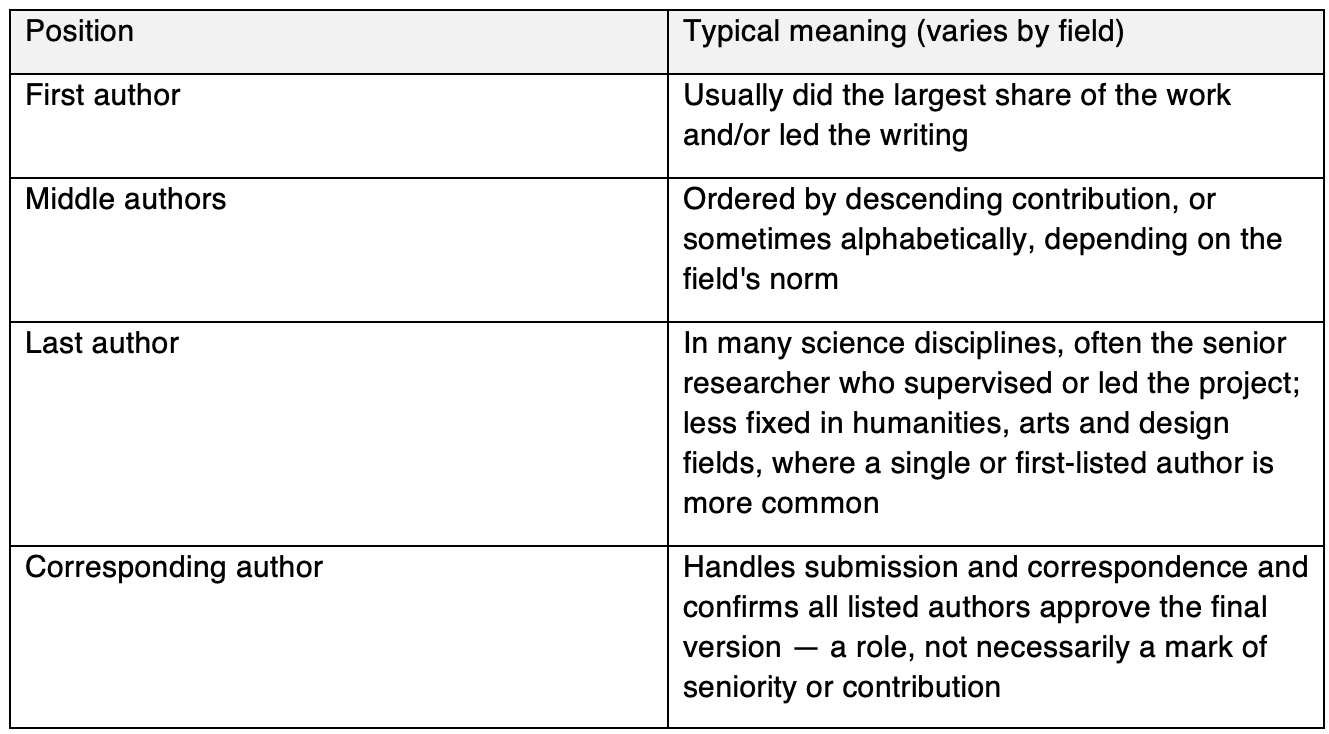
Because practice varies, every co-author should be able to explain why the order was chosen if asked. Agree the order as early as possible — ideally at the start of the project — and confirm it again before submission, since contributions (and therefore the fair order) can shift as a project develops.
Authorship vs acknowledgment
This is usually where the difficulty lies: someone was genuinely involved in a project, but their involvement doesn't meet all four authorship criteria above. ICMJE gives a clear list of contributions that, on their own, merit an acknowledgment rather than authorship:
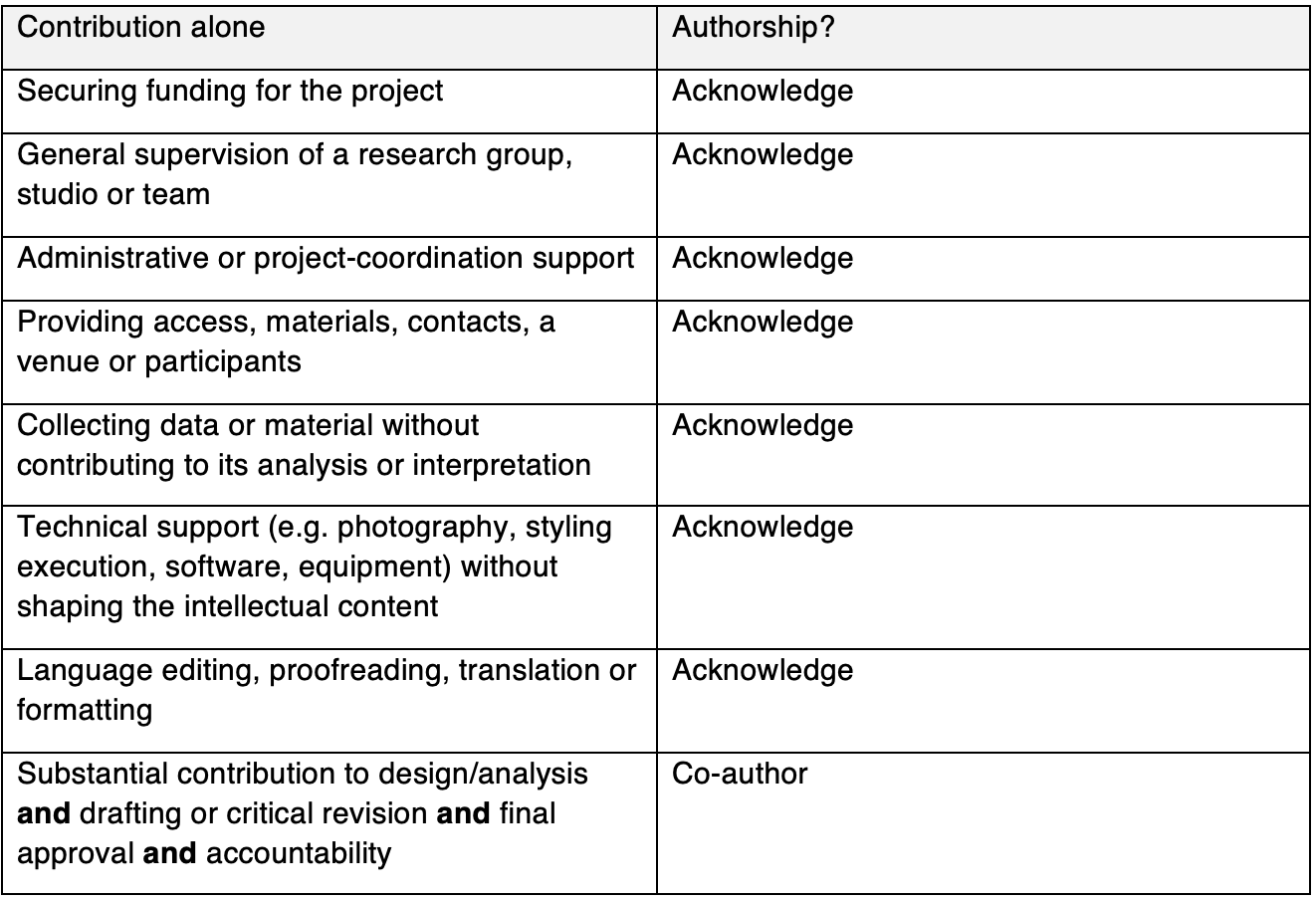
Worked example: A contributor takes part in some of the project's research activities — say, part of the data collection or fieldwork — but doesn't contribute to drafting or revising the text, and doesn't read the final version before it's submitted. Their research contribution may go some way to meeting criterion 1, but without any contribution to drafting or critical revision (criterion 2), and without genuinely reading and approving the final version (criterion 3), the full test isn't met — whatever the value of their contribution to the project as a whole. The right outcome is a clear, agreed acknowledgment of their role, rather than co-authorship.
In short: involvement in the project is not the same as intellectual contribution to the written, analytical or creative-critical work that becomes the publication. Someone can be an essential, valued part of a project — a collaborator, a supervisor, a gatekeeper to access — without qualifying as a co-author of the resulting paper, chapter or article.
A practical note: because being named in the Acknowledgements can look like that person endorses the work, it's good practice to ask their permission before naming them there.
Agreeing authorship in practice
COPE and ICMJE both stress that most disputes are avoided by agreeing authorship early and in writing, rather than assuming it.
One point worth stating explicitly, especially to colleagues newer to formal research: authorship is based on contribution to the paper, not on employment status, contract type, or whether the time involved was paid or unpaid. Being a full-time, salaried researcher doesn't mean one person is expected to carry all the drafting and review alone; equally, being part-time, unpaid, or new to research doesn't reduce what's required to be named as a co-author. Everyone named still needs to meet all four criteria above, however their time on the project was structured
Discuss likely authorship and order with all contributors as early as possible — ideally when a project starts, and again once writing begins.
Be explicit about what each person is expected to contribute (design/analysis, drafting, review, data or material) — this also makes it obvious in advance who will and won't meet the authorship bar.
Revisit the list if contributions change significantly as the project develops — someone who joins late and drafts a section may earn authorship; someone expected to write but who doesn't may not.
Before submission, circulate the final draft, the author list and the order to everyone named, and get explicit confirmation from each person that they approve it.
If there's disagreement, resolve it before submission using this guidance as the shared reference point; if it can't be resolved between contributors, raise it with your research/programme lead or Head of Department.
Quick-reference checklist
Before listing someone as a co-author, check:
☐ They made a substantial contribution to the conception/design, or to acquiring, analysing or interpreting the data or material
☐ They drafted part of the text, or critically revised it in a way that shaped its content
☐ They have read and approved the final version being submitted
☐ They agree to be accountable for the work if questions arise about it later
☐ If any box is unchecked, they should be acknowledged instead, not listed as an author
☐ The full author list and order have been shared with, and approved by, everyone named
☐ Everyone named can explain why the order was chosen
☐ A corresponding author has been agreed
Sources
• ICMJE — Defining the Role of Authors and Contributors
• COPE — Discussion document: Authorship
• CRediT — Contributor Role Taxonomy
• Office of Research Integrity (US) — Authorship and Publication
Next……Summarising your research