
GUIDANCE FOR NEW RESEARCHERS
RESEARCH AND DESIGN:
UNTANGLING THE RELATIONSHIPS
Why this guidance exists
When you describe your methodology — in a proposal, an ethics application, a progress review, or your final thesis or report — you may need to characterise the relationship between your research and your design or creative practice. A cluster of overlapping terms circulates for this purpose: research-led design, design-led research, research for design, research through design, research into design, design as a research method, practice-based research, practice-led research, and others. These terms are not used consistently across institutions, disciplines or supervisors, and it is common for researchers to feel uncertain which one applies to their own project.
This sheet sets out the main distinctions in a logical sequence, from the foundational framework most design research draws on, through to more specific and more loosely used pairings. It is intended as a shared reference point — not as a rulebook. Always check how your own programme and supervisor use a given term before relying on it in formal writing, since usage genuinely varies.
1. The foundational distinction: Frayling’s three categories
Christopher Frayling’s 1993 paper ‘Research in Art and Design’ remains the most widely cited framework for describing how research and design activity relate to one another. Frayling proposed three categories, distinguished by the role design plays in each: as the subject being studied, as the goal the research serves, or as the method of inquiry itself.
Research into design — design is the subject of the research. The researcher studies design itself — its history, theory, criticism, or the working practices of designers — using methods established in other disciplines (historical, social-scientific, aesthetic or perceptual analysis). The output is conventional academic writing about design; no creative artefact needs to be produced.
Example: a historical study of how a fashion house’s silhouette changed across three decades, or an analysis of how consumers perceive sustainable packaging.
Research for design — design is the purpose the research serves. Research is carried out in order to inform, support or evidence a piece of design work — user research, material testing, trend or archival research — and the resulting knowledge is embodied in the final designed artefact rather than written up as the primary contribution. The written component explains what was researched and why; the design object carries the outcome.
Example: consumer interviews and fabric testing carried out to inform a new collection, where the collection itself is the primary output.
Research through design — (sometimes ‘research by design’) design activity is the method of the research. The researcher makes things — prototypes, garments, models, experiments — as the means of generating new knowledge, often about questions that reach beyond design itself. The making is not illustrating conclusions reached elsewhere; it is how the conclusions are reached.
Example: iteratively prototyping smart-textile samples to build new understanding of how the body responds to responsive materials.
Frayling himself noted these three are not mutually exclusive. Most substantial postgraduate projects draw on more than one at different stages — for instance, research for design at the outset, moving into research through design during studio development.
2. Design as a research method
‘Design as a research method’ (or ‘design-as-method’) is closely related to — and often used interchangeably with — research through design. It names design activities themselves (sketching, prototyping, making, styling, pattern-cutting) as legitimate methods of inquiry, comparable to an interview or an experiment, rather than treating design only as the deliverable that follows research. The term is common in fields such as human–computer interaction and service design, associated particularly with Zimmerman and Forlizzi’s (2007) work on research through design, where designers build artefacts specifically to surface knowledge that could not be reached through analysis alone.
3. Practice-based and practice-led research
These two terms are frequently confused, but a widely used distinction — following Linda Candy’s definitions (2006), echoed in RIBA and UK doctoral guidance — turns on where the primary contribution to knowledge actually sits.
Practice-based research — the creative artefact (the collection, the garment, the film, the object) is itself a significant part of the original contribution to knowledge. A full account of the contribution cannot be given through written text alone; the reader, examiner, or audience must engage directly with the artefact, usually submitted alongside a supporting written commentary.
Practice-led research — the research is concerned with, and conducted through, practice, but the resulting new understanding can be fully articulated in writing without the artefact itself needing to be examined. RIBA’s definition — research ‘by practitioners, in practice, about practice’ — captures this: practice is the site and method of the inquiry, but the contribution is expressible in text.
A simple test: if you removed the physical or creative artefact from your submission, would the contribution to knowledge survive intact? If yes, you are likely closer to practice-led research; if no, closer to practice-based research.
‘Practice as research’ is sometimes used as a broader umbrella term covering both, particularly in performance and fine art contexts, without distinguishing where the knowledge claim sits. If you encounter it, ask which of the two more specific senses is intended.
4. Research-led design and design-led research
These two terms are used more loosely than Frayling’s triad or the practice-based/practice-led distinction, and you will find them applied inconsistently across institutions. They remain useful, however, as a quick way of describing the direction of primacy in a project — that is, which activity comes first and drives the other.
Research-led design — research comes first and steers the design decisions that follow. The design is, in effect, a response to — or application of — research findings established in advance (closely related to ‘research for design’).
Design-led research — design activity comes first, and is used to generate the questions, insights or knowledge that research then articulates and interprets (closely related to ‘research through design’ / ‘design as a research method’). Here, making precedes — and produces — understanding, rather than following from it.
In practice the two operate as a spectrum rather than a strict binary, and a single project may move back and forth between them across its different stages.
5. Related approaches you may encounter
Action research — an iterative cycle of planning, acting, observing and reflecting, typically carried out by a practitioner within their own professional or creative practice. It is frequently used within practice-led design research because it offers a structured way of treating successive rounds of making and evaluation as method.
Research about design / research on design — broadly synonymous with research into design.
Research by design — used in some disciplines, notably architecture and urban design, largely interchangeably with research through design.
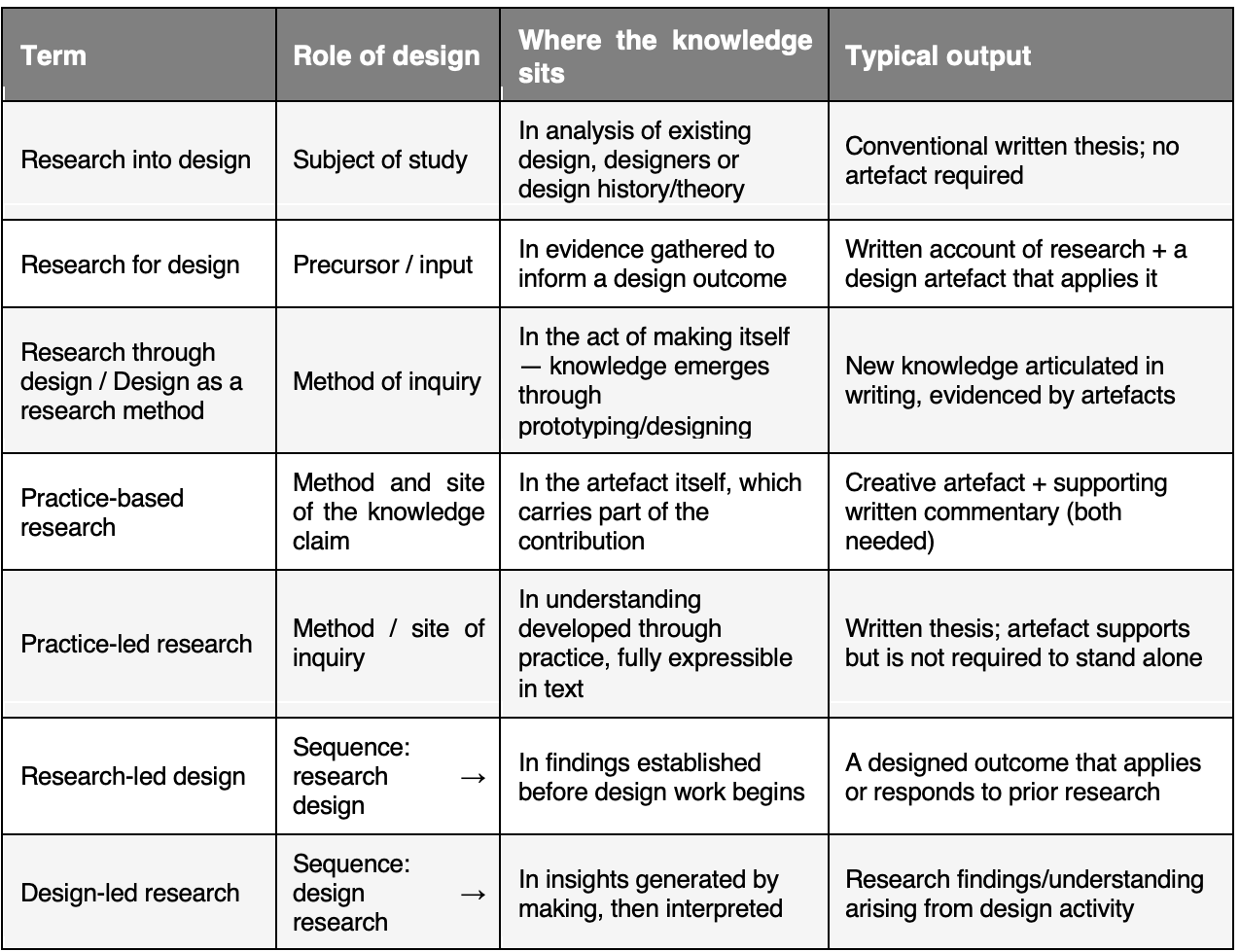
6. Quick reference table
Use this table as a fast way to locate a term and check its neighbours. Terms in the same row of the table above and below it are often confused with one another — read across before settling on a label for your own project.
7. Working out which approach fits your project
These questions are a starting point for a conversation with your supervisor or research team, not a diagnostic test with a single correct answer.
1. What is the primary contribution to knowledge in your project — is it a piece of writing, a creative artefact, or both together?
2. Does your making or design activity happen before your enquiry begins (so that it can be studied), during it (as the method of inquiry), or after it (as an application of findings)?
3. If your creative output were removed from your submission, would your contribution to knowledge still stand on its own?
4. Are you studying design as an object, using design as a method, or producing design as an outcome — or some combination of all three?
5. Might different stages of your project use different approaches? Most projects are not purely one type from start to finish.
8. A final note
Most design projects combine more than one of these approaches across their lifespan — for example, research for design at the outset (contextual and market research), moving into research through design during studio development (iterative prototyping), and articulated using practice-led or practice-based framing at the point of examination. There is no single ‘correct’ label for a whole project. The goal is to be able to explain, precisely and consistently, how research and practice relate to one another at each stage of your own work, and to use terminology in the way your supervisor/audience will expect.
Key references and further reading
1. Frayling, C. (1993) ‘Research in Art and Design’, Royal College of Art Research Papers, 1(1).
2. Candy, L. (2006) Practice Based Research: A Guide. Sydney: Creativity & Cognition Studios, University of Technology Sydney.
3. Royal Institute of British Architects (RIBA), guidance on practice-led research in architecture.
4. Archer, B. (1995) ‘The Nature of Research’, Co-Design, Interdisciplinary Journal of Design.
5. Zimmerman, J., Forlizzi, J. and Evenson, S. (2007) ‘Research Through Design as a Method for Interaction Design Research in HCI’, Proceedings of CHI 2007.
6. Findeli, A. (2010) ‘Searching for Design Research Questions’, in Design Research Now, Basel: Birkhäuser.
Prepared for IML researchers. Terminology in this field evolves and is used differently across institutions — treat this as a starting point for discussion, and update it as your own department’s conventions become clear.
Next……Summarising your research